

Explore our services
Find the right engagement for your systems and security goals. Our senior specialists combine hands-on testing with in-house research, machine learning and automation.
Adversary simulation & red teaming
Test how well your people, processes and technology withstand a realistic attack, and identify where detection and response need to improve.
Coverage
- Threat intelligence-led attack simulations
- Identity, cloud and internal attack paths
- People, physical and technical controls
What you receive: An account of the attack paths tested, control gaps and business impact, with prioritised recommendations and a stakeholder readout.
Explore methodology
Metric-Centric, Repeatable Approach
Our consultants have experience delivering on regulated adversary simulation engagements under the CBEST, TBEST, TIBER-EU and other frameworks, so we understand threat intelligence led security testing.
Our adversary simulation capabilities are designed for organizations with extremely high threat profiles, where realism, control and repeatability are non-negotiable.
What We Test
We can mount attacks against the People, Process and Technology layers in full spectrum threat actor simulations where the following controls are assessed:
Perimeter Controls
- Employee Security Awareness and Phishing resilience
- Email Filtering
- Email Anti-Spoofing Mechanisms
- DNS Filtering
- Web (HTTP / HTTPS) Filtering
- Network Filtering
Workstation Controls
- Workstation Hardening
- Antivirus / Anti-Malware
- Application Whitelisting
- Protection of Privileged Accounts - Local Administrators
- Application Security Settings
- Employee Laptop Protection
Internal Controls
- Malicious Network Activity Detection
- Monitoring and Incident Response
- Protection of Privileged Accounts - Domain Administrators
- Protection of Privileged Accounts
- Protection of Service Accounts
- Domain Security Policy
- Data Loss Prevention
- Patch Management Policy
- Weak Password Policy
- Network Segregation
Cyber High-Level Methodology
Our methodologies are mapped to the MITRE ATT&CK framework. We typically follow a six step model working our way from out to in, to fully assess operational impact.

1. Recon
Profiling, SharpInfo Pretexts, OSINT

2. Exploitation
Phishing, EDR Evasion, Command Execution and C2 Callback

3. Privilege Escalation
Active Directory Enumeration, Workstation & Network Share Enumeration – patch levels, password policy, file shares, ADCS

4. Lateral movement
SharpHound, AzureHound, Certify, WinRM, RDP, AdXplorer, SharpML, SharpSniper.

5. Persistence
Registry, WMI, VPN, Scheduled Tasks, COM, ‘Living off the land’, DMZ Web Shells.

6. Operational impact
Comprehensive Reporting and Presentation around business and operational impact.
Identity-Based Red Teaming (2025/2026)
Identity control planes now define blast radius. We test how attackers chain identity, SaaS, and cloud trust to move laterally without noisy infrastructure compromise.
IdP & SaaS Control Plane
Assess identity provider configurations, SaaS admin surfaces, and governance gaps that enable persistence.

Privilege & Trust Pathing
Map trust relationships, service principals, and role sprawl across hybrid estates to expose escalation paths.
Token & Session Security
Test session lifecycle controls, conditional access, and token hygiene to reduce identity-driven lateral movement.
Operator Tooling & R&D
Our R&D is embedded in this work: we operate our own Turul GAN and Turul C2 stack, and we build bespoke tooling for mission-specific tradecraft. Explore our R&D program.
Physical Intrusion Methodology
When performing Red Team assessments in the United States, or where our client requires a physical component, our methodology is outlined below.
1. Recon
Planning, Long and Short Range Reconnaissance

2. Preparation
Operational Planning, Intelligence Review, Resourcing
3. Mobilisation & Staging
Suit Up, Test equipment, Comms, Deploy

4. Manoeuvre Operations
Environmental Conditions, Observation, Cover & Concealment, Signaling
5. Strike and Penetrate
Character Change, Movement, Establish Position, Execution, SITREP, Mission Standing.
6. Operational impact
Comprehensive Reporting and Presentation around business and operational impact.
Cloud & infrastructure testing
Identify exposed services, configuration weaknesses and attack paths across cloud and on-premises environments.
Coverage
- AWS, Azure and GCP environments
- Internal and external networks
- Hybrid identity and network segmentation
What you receive: A risk-rated findings report with evidence of exploitable weaknesses and practical remediation priorities.
Explore methodology
Network, Infrastructure & Cloud
Whether you are a digital asset provider with some Azure cloud infrastructure, or an international telecoms organisation with hundreds of thousands of public IPs, we can thoroughly assess your network infrastructure (on-prem or cloud) with expert level attack coverage.
We cover hybrid estates across AWS, Azure, and GCP, focusing on exposed services, identity pathways, segmentation gaps, and cloud control-plane misconfigurations that drive real-world risk.
On-Prem Infrastructure
Assess routing, segmentation, legacy services, and internal attack paths across critical systems.
Cloud Environments
Test cloud posture, identity controls, storage exposure, and control-plane security in AWS, Azure, and GCP.
Hybrid Attack Surface
Validate cross-environment pivots, VPN and SD-WAN boundaries, and shared identity trust.
Scope
Atlan Digital R&D works with you to develop a detailed scope of the penetration testing to be undertaken.
Recon
In the first phase Atlan Digital R&D will perform OSINT, analysing the routing mechanisms, and then all your systems will be scanned for all active TCP and UDP ports and we will establish the security rule-base.
Exploit
In the exploitation phase Atlan Digital R&D will iteratively identify and exploit vulnerable systems using public vulnerability information, and configuration & design errors. A scenario analysis over the entire network is conducted.
Report
In the final phase Atlan Digital R&D will perform comprehensive reporting of the issues identified. The risks will be rated according to numeric CVSS scores alongside an internal qualitative risk grading.
Web application penetration testing
Find weaknesses in your web applications before attackers can compromise accounts, expose data or misuse critical functionality.
Coverage
- Application functionality and business logic
- Authentication and session management
- Platform configuration and input handling
What you receive: A risk-rated report explaining the vulnerabilities found, their impact and recommended fixes.
Explore methodology
360° Coverage on Web Application Pen Tests
Enterprise applications, e-commerce platforms, trading systems, SaaS platforms and other web first components dominate the corporate landscape. We work to comprehensively assess their security posture for known and unknown security vulnerabilities.

Methodology
Our methodology is built upon the PTES and the OWASP TOP 10 Framework, also informed by our team’s experience of conducting 100s of application tests.
Fingerprinting
Mapping web app, hosts, content scripts and files. Source code analysis, developer commands, client side validation, applet and class decompilation.

Platform Enumeration
Exploit known OS and application vulnerabilities. Attempt to use default insecure configurations.

Application Functionality
Circumvent application normal processing through parameter poisoning, directory traversal, XXE, HTML form modification, SQL command insertions, unauthorized database access and database corruptions.

Authentication
Cookie examination, session re-use, sensitive cached information. Intrusive account testing including brute forcing user accounts and password attacks.
Reporting
Comprehensive reporting risk rated by both CVSS3 and Atlan.
LLM penetration testing

Understand how your AI applications and models could be manipulated, expose sensitive data or take actions outside their intended boundaries.
Coverage
- Prompt injection and data exposure
- RAG pipelines, tools and agent workflows
- Model safeguards and misuse scenarios
What you receive: Documented failure scenarios, an assessment of control gaps and recommendations aligned to your application and model risks.
Explore methodology
Application Security & Frontier Model Safety
We provide dedicated security testing for LLM applications and frontier models, combining red teaming methodologies with application security review to identify model misuse, data exposure and control failures.

LLM Application Security Testing
Prompt injection, data exfiltration, tool abuse, retrieval risks, agent workflow manipulation and guardrail bypass testing for production LLM applications.

LLM AppSec Review
Threat modelling, access control verification, RAG pipeline review, prompt and system message analysis, and evaluation of output filtering and monitoring.

Frontier Model Testing
Safety red teaming, misuse pathway discovery and evaluation of jailbreak resilience, autonomy risks and high-impact capability safeguards.
Model Evaluation & Governance
Evaluation harness design, red team scenario planning, policy testing and reporting aligned to organisational risk governance.
Mobile penetration testing
Assess how your Android and iOS applications protect sensitive data and interact with devices and supporting services.
Coverage
- Android and iOS applications
- Static and dynamic application analysis
- Local storage and remote service interactions
What you receive: Findings from application analysis and runtime testing, with remediation guidance for your development team.
Explore methodology
Mobile Application – Android & iOS
As an extension of web applications, mobile applications can allow extended functionality, whether as a transaction signing mechanism, custom 2 factor authentication solution, or thick client providing business critical functions, we inspect these applications at the deepest levels.
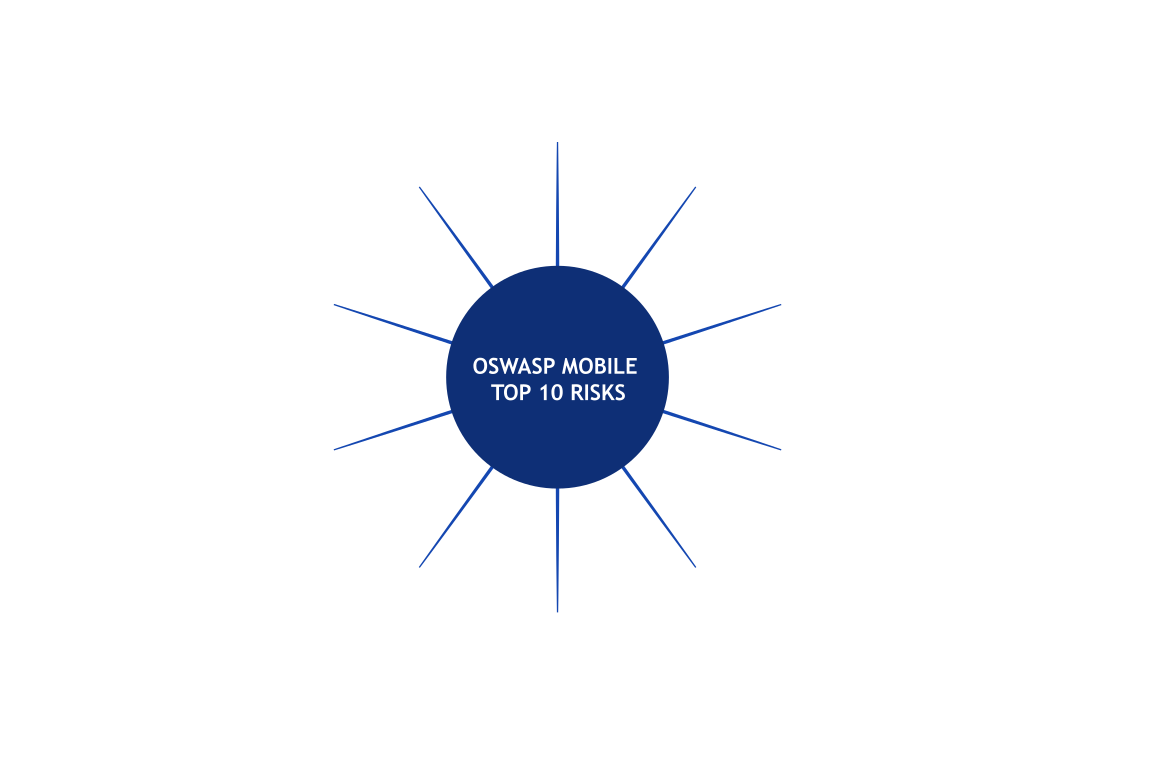
OWASP Top 10 – Mobile
While specific techniques exist for individual platforms, a general mobile threat model is used by Atlan Digital R&D when creating a mobile security testing methodology for any platform.
Prerequisites/Planning
Tasks and requirements before conducting the mobile security assessment.
Information Gathering
The steps and considerations in the early reconnaissance and mapping phases of testing.
Static Analysis
Analyzing raw mobile source code, decompiled or disassembled code.
Dynamic Analysis
Executing an application either on the device or within a simulator/emulator and interacting with the remote services. Includes local inter-process communication surface, forensic analysis of the local filesystem, and remote service dependencies.
ICS & SCADA penetration testing

Identify weaknesses in industrial systems through a staged assessment planned around your operational requirements.
Coverage
- Industrial devices and network topology
- System configuration and threat modelling
- Agreed offline and live test scenarios
What you receive: Consolidated findings and remediation recommendations, reviewed with stakeholders in the context of your operational risks.
Explore methodology
Industrial Control Systems (SCADA)
Critical infrastructure provides much of the backbone of a city’s, or even a country’s successful operational ability. In troubling times, these systems can be high priority targets for nation states or advanced cyber criminal groups. We can apply our methodologies to help identify weak points and security risks to allow you to mitigate them.
Scope
- Define business purpose of engagement
- Determine sensitivity of business functions and processes
- Create and agree ICS business process model
- Confirm specific systems, devices and infrastructure in scope
- Confirm composition of testing team
Assess
- Gather threat intelligence
- Conduct threat modelling exercise
- Determine major vulnerabilities
- Assess risks and priorities
- Agree risk-based approach to testing
Discovery
- Conduct ICS device discovery exercise
- Determine network topology
- Gather and review ICS network and device configuration information
- Create and agree ICS technical infrastructure model
Test Plan
- Create test scenarios
- Determine offline and online tests
- Determine resource requirements
- Create and agree progressive test schedule
Live Testing
- Undertake and document offline and online tests
- Analyse test results and consolidate findings
- Document ICS environment remediation recommendations
- Review findings with key stakeholders
Secure code review

Find security flaws in your source code and give developers the context they need to address weaknesses before deployment.
Coverage
- Manual review and automated static analysis
- Targeted dynamic analysis
- Developer interviews and architecture context
What you receive: Code-level findings, recommended fixes and knowledge transfer to support your secure development practices.
Explore methodology
JavaScript, Ruby, Infra as code, NodeJS, Python, .NET, C/C++
Finding security vulnerabilities before applications reach deployment stage is critical. We can work with your developers collaboratively to bake in security or even help you develop a Secure Development Lifecycle (SDLC).
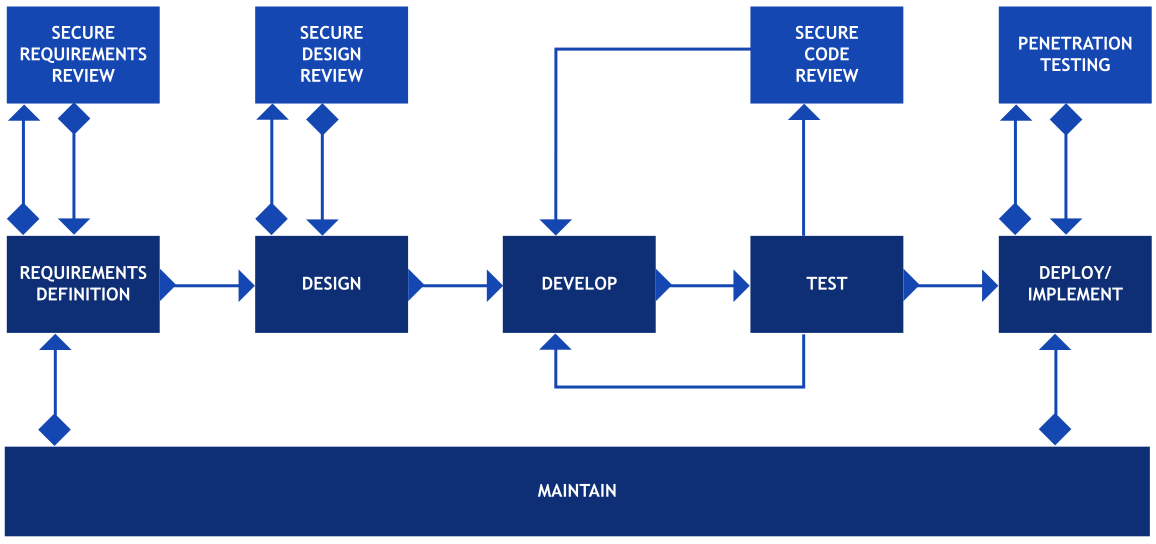
Secure Code Review:
Reviews are performed in alignment with industry proven best practices, guidelines and standards from organisations such as OWASP, MITRE, CERT and NIST.
Prerequisites/Planning
Evaluating tasks and requirements for conducting the code review, as well as assessing the application’s magnitude and scope of effort required.
Static Analysis
Analysing raw source code, using manual techniques and automated scanners that highlight code hotspots.
Developer & Architect Interviews
We work closely with developers to expedite understanding of the code and architecture, and provide knowledge transfer.
Information Gathering
Review of the application’s supporting documentation and development guidelines, identifying intended purpose, functionality and development approach.
Dynamic Analysis
Working in combination with static analysis; we perform dynamic analysis of the code where it is unreachable statically or where efficiency is improved dynamically.
Software development
Build bespoke security software with engineers who understand the code, the threat and the operational problem you need to solve.
Coverage
- C#, C++, Rust and Python development
- Machine learning and statistical modelling
- Security tooling and Turul integration
What you receive: Bespoke software, research components or integrations, with the deliverables and handover agreed during scoping.
Explore engineering capabilities
Security domain knowledge, built into your software.
Our specialist contractors combine software engineering with hands-on security experience. We develop bespoke solutions in C#, C++, Rust and Python, applying machine learning, statistical modelling and security review to problems that demand an understanding of both the code and the threat.
We can support your existing team with focused development, research and integration, or bring together the contractors needed to deliver a defined security engineering project.
Applied capability: TurulGAN
TurulGAN brings this expertise together: machine learning and statistical modelling guide C# binary transformation, with build automation and verification against endpoint detection systems. It demonstrates how we turn security research into repeatable tooling for operators.
We can support Turul deployment and integration through APIs, SDKs and build pipelines, and develop bespoke components that connect it with your existing tooling and workflows.
SOC & detection engineering
Tools for alert triage, telemetry analysis, detection validation and investigation workflows. We apply security domain knowledge and statistical analysis to help teams assess signals and automate repetitive work.
Malware & phishing research
Analysis tooling, controlled simulations and evaluation environments for malware, phishing and related threats. Specialist contractors can develop the components needed to test controls and support defensive research.
ML & statistical modelling
Classification, clustering, scoring and model evaluation for security data. We can build experimental models and evaluation pipelines, measure their performance, and integrate useful results into your applications.
Security review & bespoke integration
Source code review, threat modelling and architecture assessment alongside development. We can connect Turul and other bespoke solutions to your security platforms, APIs and internal systems.
Enquiries
Tell us which systems you want to assess or what you need to build. If you are unsure which service fits, select “Not sure yet” and describe your goals.
Contact Us
How can we help?
Whether you represent a corporate, a consultancy, a government or an MSSP, we’d love to hear from you. To discover just how our offensive security contractors could help, get in touch.